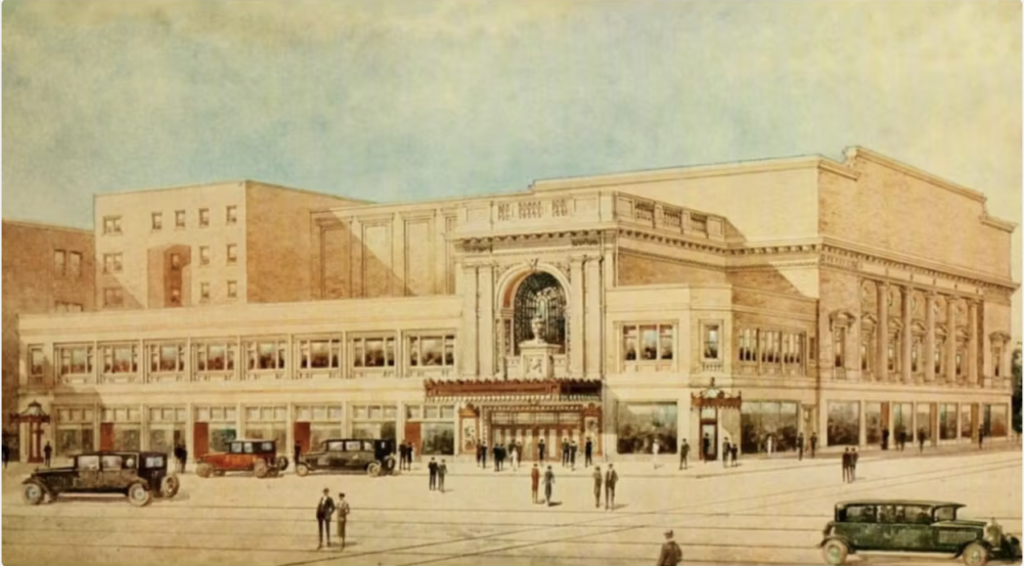
Front view of The Erlanger Theater. Architectural Rendering by Hoffman-Hennon Co..
A Brief Overview of Erlanger’s life

Our story starts with a boy in short trousers working after school hours. A. L. Erlanger began his career in the entertainment world selling opera glasses at the old Academy of Music in Cleveland. Little is known about his upbringing, but it can be imagined that the boy was deeply fascinated by the spectacles and absorbed in all the specifics about theatrical productions in his early years. His first appearance in public records occurred in young manhood, when he decided to partner up with Kentucky lawyer Marc Klaw to form the famous K&E corporation. They put into operation the first orderly plan of sending theatrical attractions on tour, revolutionizing the booking methods of the theater and establishing systematic booking networks throughout the US, eventually gaining such power that he was assailed as a “czar” by his competitors. In 1896, Erlanger engaged in the formation of the Theatrical Syndicate, a six-man group which, in effect, created a monopoly that controlled every aspect of contracts until the late 1910s when the Shubert Brothers broke their hold in the industry.
Upon his death, Erlanger owned or controlled more than thirty theaters (including 9 in New York City and 3 in Philadelphia), and was the largest individual theater owner in the world [1].
Although mostly involved in the more traditional forms of theatrical production such as vaudeville, musical, and opera, Erlanger had long recognized the potential of motion pictures. As early as 1915, he allied with Paramount, forming a $2,000,000 corporation [2]. The organization served to extend Paramount service to cities which it did not reach at the time and to procure suitable theaters in those cities for the showing of Paramount pictures.
Throughout the 1910s and early 1920s, Erlanger and his arch rivals, the Shubert brothers, were in a constant state of business and publicity war, both engaging in unsavory strategies such as mutually destructive booking tactics. Countless agreements were made and then broken. Noticeably, on June 23, 1923, Erlanger-Shubert announced an alliance to present motion pictures in their theater chains [3]. Erlanger released a statement that he, with Lee and Jacob J. Shubert, will form a chain of theatres, which, under their booking management, will be exclusively devoted to the presentation of motion picture spectacles of the highest class.
“After a careful survey of the field we have come to the conclusion that the time is ripe for the organization of a new chain of theatres throughout the country, to be devoted exclusively to the artistic presentation of those great motion picture stories that are developed occasionally to a point which warrants this special attention.”
The Erlanger Theater
Zooming into Philadelphia, prior to 1927, Erlanger and the Shubert brothers had jointly managed the original Forrest Theater on Broad and Sansom Streets. After the Fidelity-Philadelphia Trust Company decided to demolish the theater to build their new office building, Erlanger joined forces with the Stanley Theatre Co. of Philadelphia to build a new playhouse at Market and 21st Streets, from which the Shuberts would be excluded. *The Shuberts retaliated by announcing plans for their new playhouse at 1114 Walnut Street, which became known as the Forrest Theatre today [4].

The Erlanger Theater, Under Construction, 3/17/1927.

The Erlanger Theater, Under Construction 6/15/1927.
Designed by Hoffman-Hennon Co., the Erlanger Theater in Philadelphia, originally built for stage productions, officially opened on October 3, 1927 [5]. The stock ownership was divided equally between Erlanger, Charles B. Dillingham (also a theatrical production manager and close associate of Erlanger), and the Stanley (Stanley-Warner) Company. The $2,500,000 theater was inaugurated by Fred Stone (starring Christopher Cross in the musical Criss Cross) and his daughter Dorothy (a three-week run). Mayor and city officials attended the gala performance.

Built to house an audience of 1,890, the new theater was regarded as one of the most elaborately outfitted playhouses of its kind in the country. Its opening gives Philadelphia eight legitimate first-class theaters.


Of Georgian architecture, the theater has a frontage of 183 feet on Market Street and a depth of 144 feet on 21th Street. It featured a grand lobby of Italian marble, gold-leafed columns, walnut paneling and three ornate crystal chandeliers matching in design. The Foyer featured murals by Jules Le Boutelier reflecting the first Napoleonic Empire and an inlaid terrazzo mosaic floor. Three mezzanines were recessed over the adjoining lobbies. Twin marble staircases led down to the spacious Spanish room.
The auditorium was decorated and furnished with hand-wrought irons, tapestries, chandeliers, crystal mirrors, and antique wood-work. A Spanish lounge, where both men and women may smoke, an English hunting room for men and a jade room for women, are other features of the interior.
Interestingly, Erlanger was the only theater in town with a bar in the lobby. “Odyssey” patrons were able to buy drinks before and after the show and during intermissions.
With the opening of the new Erlanger Theatre, Peter Ermitinger and Sebastian Rowan, manager and treasurer of the Galety (another Erlanger’s theater in New York), respectively, were shifted to the new house.

*The chandeliers, 60 years after its original installation in the Erlanger Theatre, continued to shine in glory when restoration of the Chicago Theater in 1986 demanded replacements for its broken chandeliers.
The theater had prospered initially. On December 20, 1927, news reported that the gross of “Show Boat” at the new Erlanger Theatre in Philadelphia was approximately $90,000, breaking the box office record [6].
Erlanger also embraced the novel “talking movie” technology actively. On August 1st, 1929, the theater became equipped with the Western Electric Sound System [7]. Erlanger stated that he had no intention of devoting his theaters exclusively to this kind of entertainment, but he realized that the sound pictures had come to stay and, as a purveyor of theatrical amusements, he wished to be able to give his patrons the very best that is offered in drama, musical comedy or pictures [8].
However, as Erlanger approached his seventies, management issues at the theater soon began to take place. On September 27, 1929, it was reported that the theater had been closed that season in consequence of the controversy between musicians’ union and theater managers, preventing its opening for stage productions [9]. In response, the theater had been leased to the RKO interests for a year, which opened on Oct. 12 with RKO’s premiere of its first “talkie,” “Street Girl.”
Noticeably, on October 8, 1928, the Stanley Company of America (shareholder and constructor of Erlanger) filed a bill in Common Pleas Court against the Forrest Theatre Operating Company (owner of the Erlanger Theater) and the Radio-Keith-Orpheum Distributing Corporation to prevent by injunction the Erlanger Theatre as a movie playhouse [10].
Despite the lavishness of Erlanger, the theater had an arguably poor location for the first run exhibition of moving pictures because it was further from the business district and the traffic center of Philadelphia than any of the established first run houses. RKO had given it up eight weeks before the lease expired. As it turned out later, when given a choice, Loew’s had operated the Keith’s as preferable to the Erlanger when it exhibited its own feature’s first run in Philadelphia. Columbia had selected the ancient Chestnut Street Opera House with its uncomfortable seats and impaired sight lines in preference to the Erlanger.
Then, on March 7, 1930, A. L. Erlanger passed away. Only a few days before his last illness he purchased an additional interest in Philadelphia in the Broadstreet Theater in Philadelphia [11]. Erlanger’s brother took over control of his theater chains, but without good business strategy and effective lead, just two years later, in 1932, the mortgage on the Erlanger Theater went into default.
In the following years, the Erlanger struggled, as it kept switching from theatrical productions to movies with constant openings and closings.
Two movies screened in 1937 caught our attention, as it showed how much the state of the theater had deviated from Erlanger’s original vision to provide only a legitimate, first-class, artistic experience for its audience:
One is RKO’s “Cloistered,” the marketing poster for which stated: “For the first time in history, cameramen have been permitted to film the mysterious life of the nuns living in a strictly cloistered Covenant- where no man ever entered before [12].”
Another is Weldon’s picture’s sexploitation epic “Damaged Lives.” The film was censored in most American towns due to its vulgar content. Columbia, the original producing studio of the film, dissociated themselves before its distribution.

Clearly, the Erlanger had sunk to showing products that appealed only to the cinema of attraction.
On November 9, 1940, the ill-fated Erlanger theater welcomed its newest owner: William Goldman. Already built a successful chain of a dozen theaters in St. Louis and having served for five years as Warner Brothers’ district manager of the 200 theaters in the Philadelphia area, Goldman decided to “strike out on his own.” Because of his break with the studio system (among many reasons), however, Goldman found himself unable to secure “any first run product from any of the major producers [13].” A prolonged story of antitrust battles, which later came to be known and concluded upon the Paramount Decree of 1948, began here.
“Civil Action No 87-273” was subsequently filed on November 20, 1940, charging the defendants of “unlawful monopoly, and attempts…combinations and conspiracies to monopolize [14].” With back-and-forth in civil actions for more than five years, the case concluded with Goldman being awarded damages for estimated loss of profits in the amount of $1,125,000. The case, however, also sparked a series of antitrust cases that attempted to appeal to and redefine the 1890 Sherman Antitrust Act, including the nation-wide Jackson Park Case [15]. The final result, as we all have known, came in 1948 with the Paramount decision, as the court ordered the divestment of major studios from their cinemas.

Title Page of the “Goldman case”
Erlanger Theater, however, did not enjoy such belated luck. As more weeks are spent closing rather than opening in a year, the theater’s marquee blacked out in 1966, and had stayed black until another set of unfortunate duos, Lawrence Katz and Samuel Rosenblum, purchased the theater “for an undisclosed sum [16].” Katz’s son and Philadelphia’s notorious bon vivant, Harry Jay Katz, took over the theater and revitalized it as “a nightclub, cafe, and theater venue.” It’s also worth mentioning how Katz originally intended to build the infamous Playboy Club as Philadelphia’s first [17]. Café Erlanger was only a second choice.
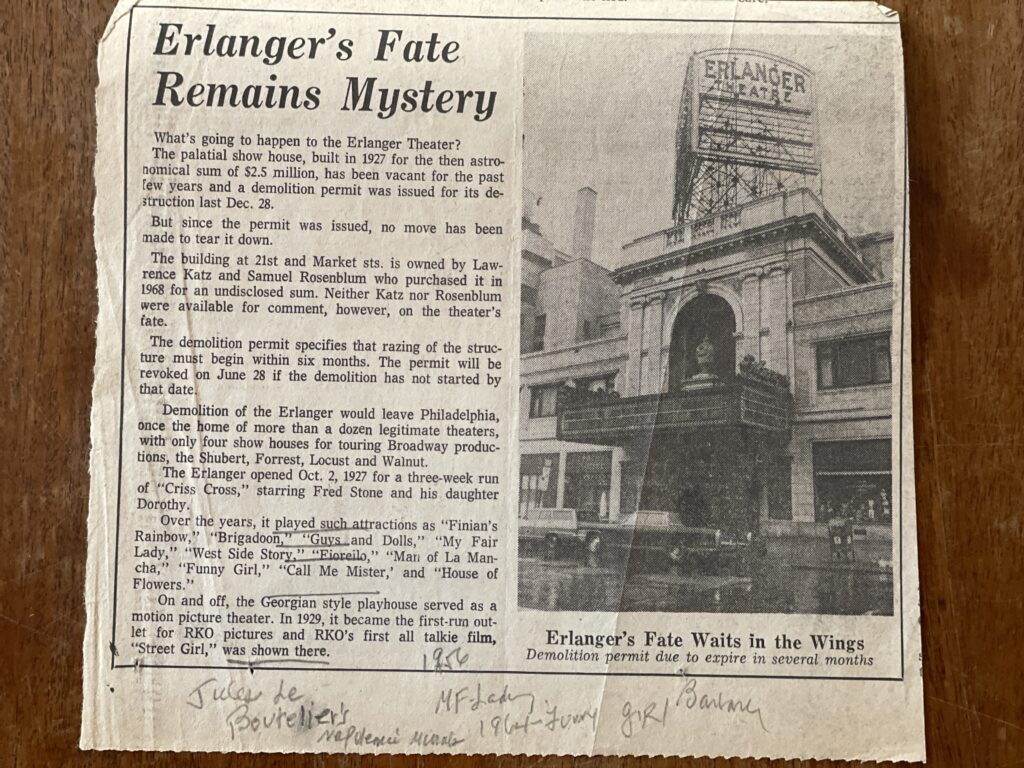
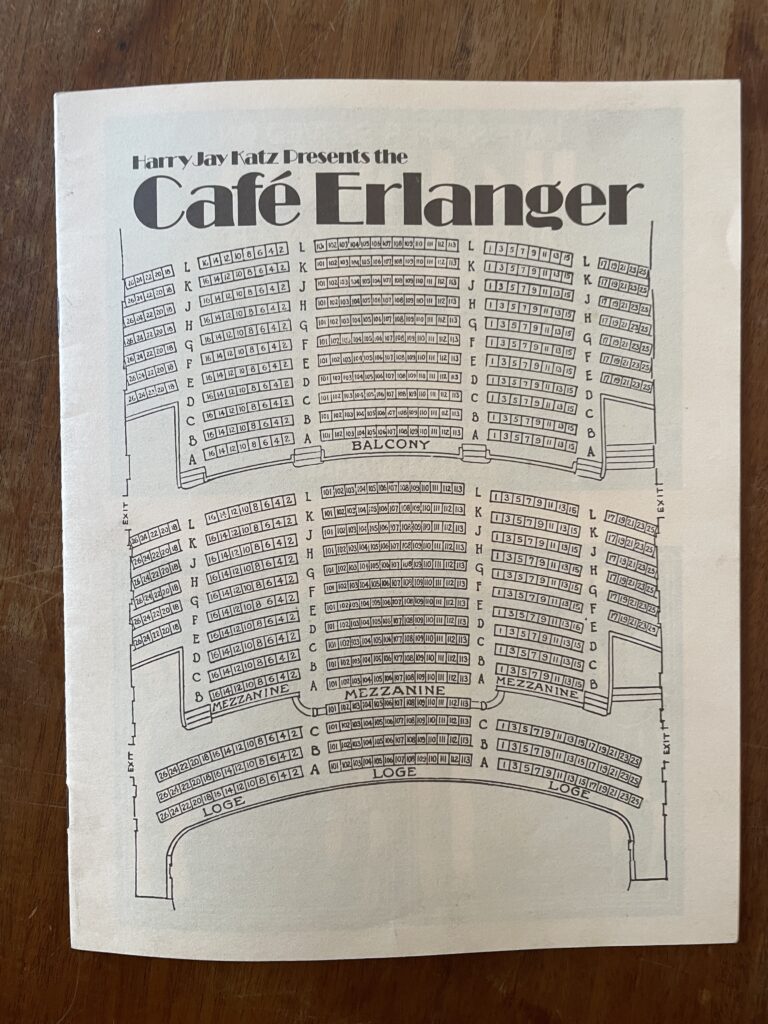
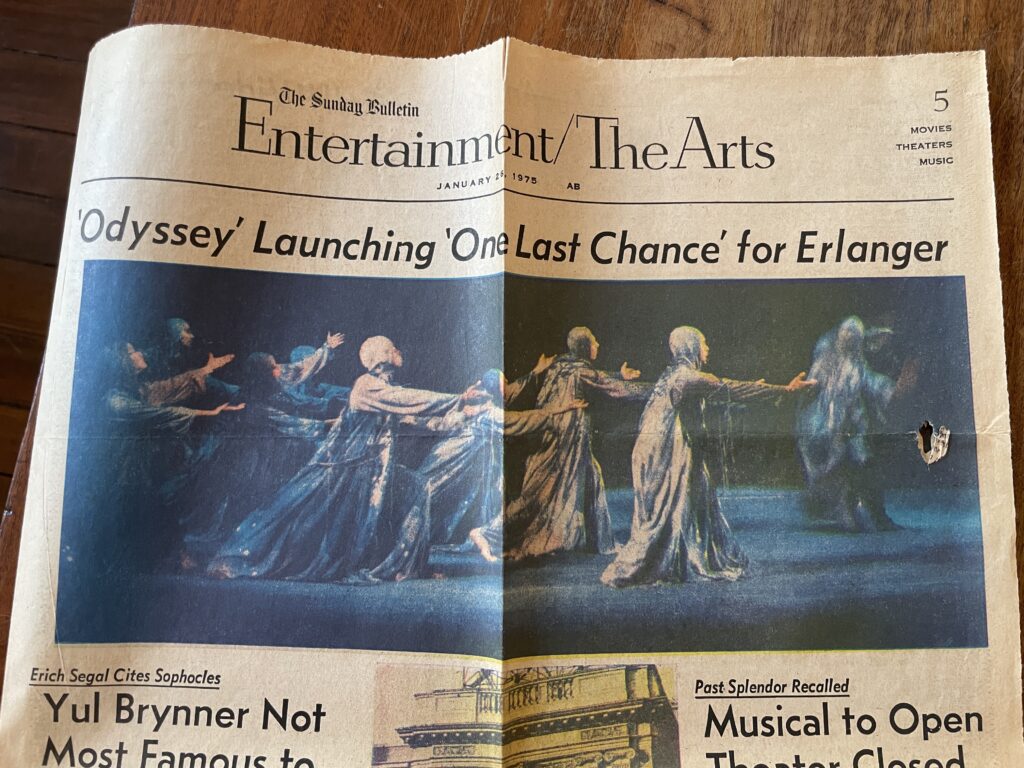
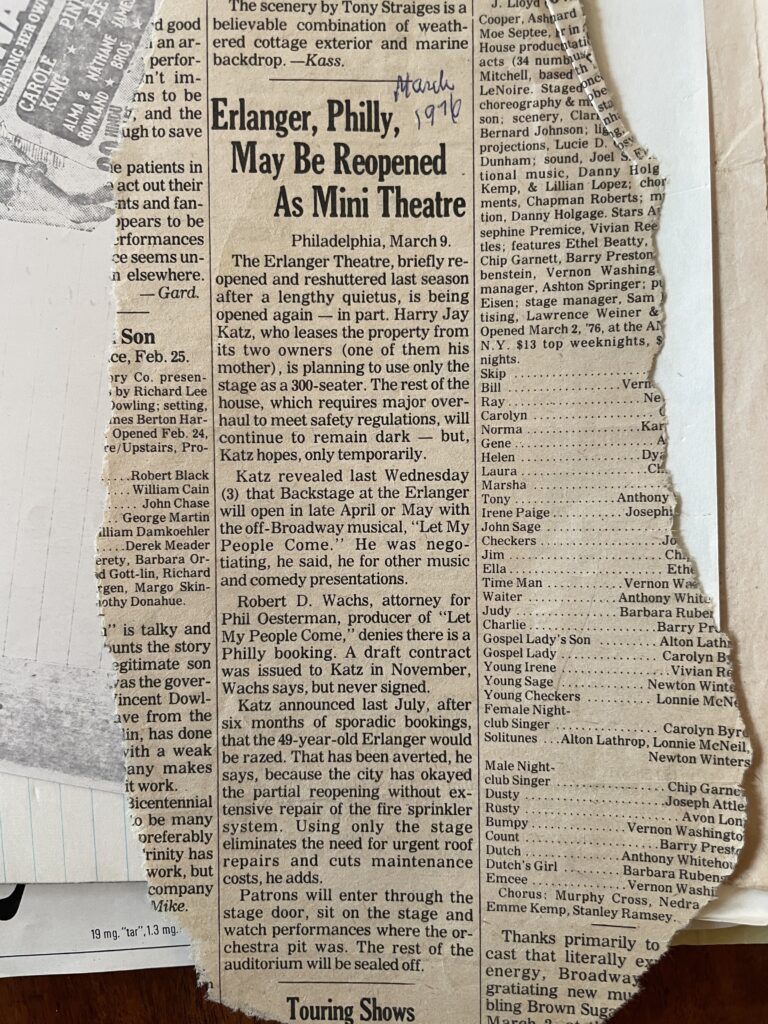
Officially opened in November 1973, Café Erlanger first enjoyed some hype, but it did not last long. Katz also tried to revitalize its theatrical business, with attractions such as Yul Brynner’s Broadway hit show “Odyssey” on Jan. 28, 1975, which was described by The Sunday Bulletin as “one last chance” for Erlanger [18]. The show indeed became widely successful, with 60,000 people seeing the show over the course of a four-week run [19]. Its success, however, did not save Café Erlanger as well, as it eventually closed down in July 1975 [20]. In March 1976, Katz made one final feeble attempt to partially re-open the theater, with most of the auditorium sealed off, with the Broadway show “Let My People Come [21].”
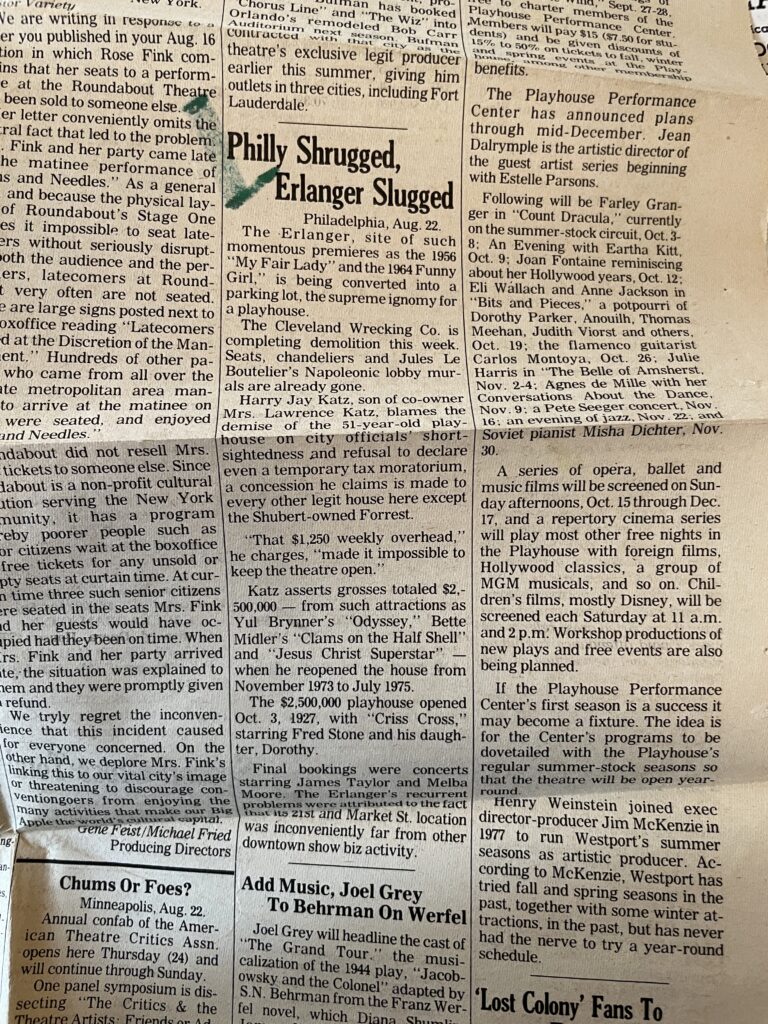
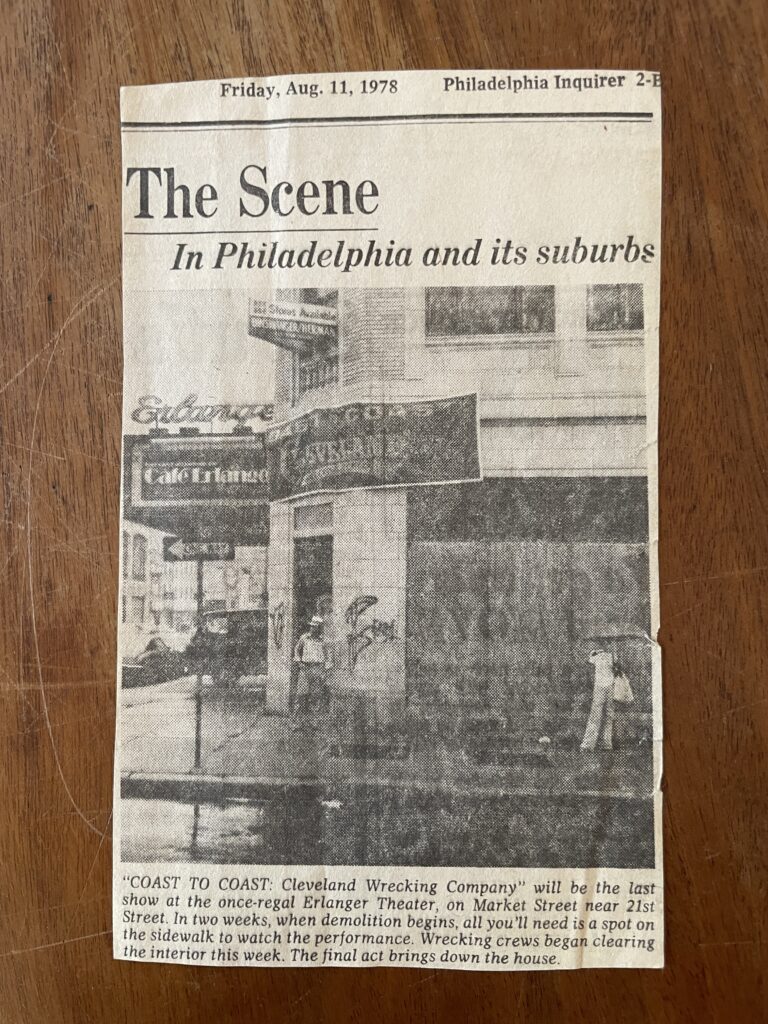
The tottering theater was eventually endowed with its long-due peaceful end in August, 1978, as it was demolished and transformed into a parking lot. Philadelphia Inquirer satirically wrote that “‘Cleveland Wrecking Company’ will be the last show at the once-regal Erlanger Theater…all you’ll need is a spot on the sidewalk to watch the performance [22].”
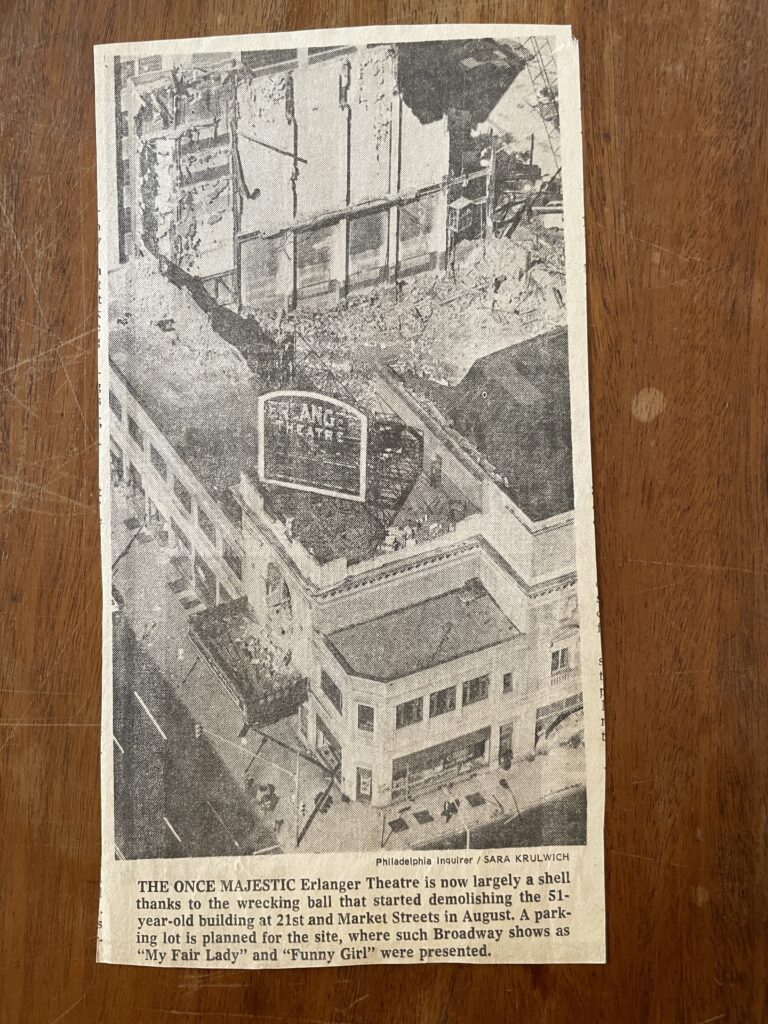
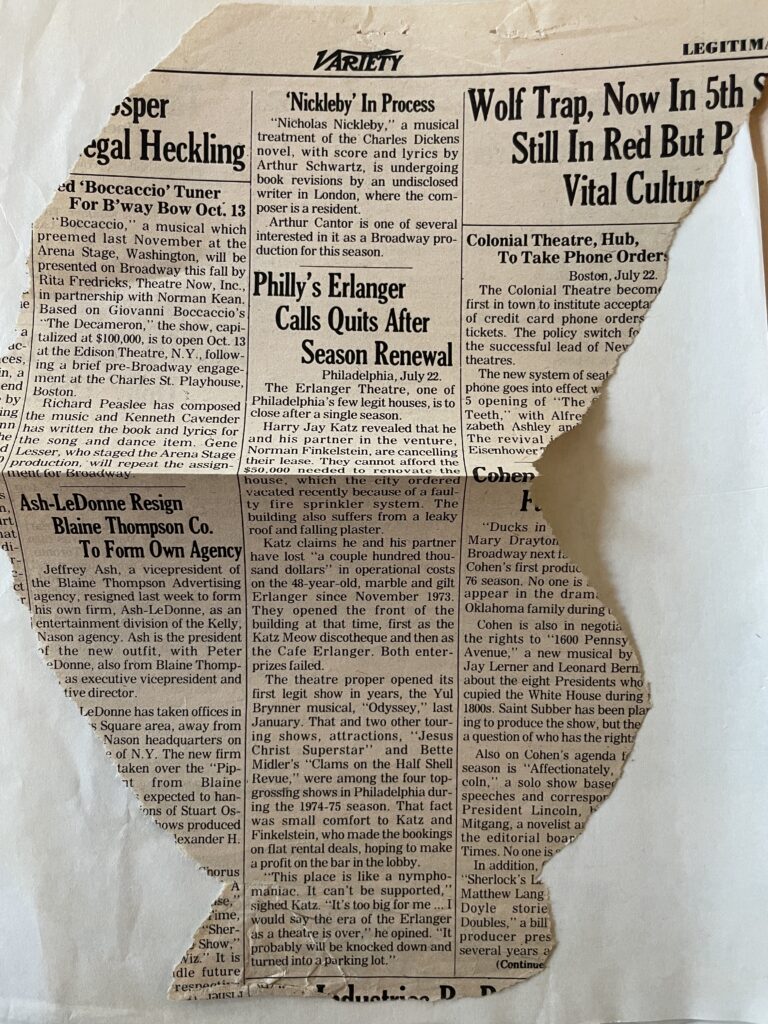
When talking about the end of Erlanger, its last owner Henry Katz derogatorily described it as a “nymphomaniac” that “can’t be supported” for a Variety newspaper article on July 22, 1976 [23]. Herbert Muschamp, an architectural critic for New York Times, has also reminisced about his childhood memory of sitting “in the last row of the second balcony of Erlanger Theater.” Despite being hardly able to “make out the stage,” Muschamp admired the ceiling and compared it to “a red-and-gold disease [24].” One must wonder, in addition to an ill-fated fever of the past century, what Erlanger has actually left behind for us all.
References
[2] https://lantern.mediahist.org/catalog/motography00test_1137
[3] https://lantern.mediahist.org/catalog/motionpicturenew00moti_1_0877
[4] https://www.forrest-theatre.com/forrest-theatre-history.html
[7] https://lantern.mediahist.org/catalog/exhibitorsherald95unse_0382
[8] https://lantern.mediahist.org/catalog/exhibitorsherald94quig_1197
[12] https://lantern.mediahist.org/catalog/motionpicturedai41unse_0566
[13] Irvin R. Glazer, draft to “The Philadelphia Erlanger theater – Legal Landmark Case”
[14] “Civil Action No. 87-273, In the District Court of the United States for the Southern District of New York, UNITED STATES OF AMERICA, PLAINTIFF V. PARAMOUNT PICTURES, INC., ET AL., DEFENDANTS, AMENDED AND SUPPLEMENTAL COMPLAINT”
[15] Irvin R. Glazer, draft to “The Philadelphia Erlanger theater – Legal Landmark Case”
[16] “Erlanger’s Fate Remains Mystery,” newspaper article, unknown publication/date
[17] Nick Vadala, “When Philadelphia almost had a Playboy Club,” The Philadelphia Inquirer, published Sept. 28, 2017
[18] “Odyssey‘ Launching ‘One Last Chance’ for Erlanger,” The Sunday Bulletin, Entertainment/The Arts, January 26, 1975
[19] “Adventure in Theater History”
[20] “Philly Shrugged, Erlanger Slugged,” Variety, August 23, 1978
[21] “Erlanger, Philly, may be reopened as mini theater,” newspaper article, unknown publication, March, 1976
[22] “The Scene, In Philadelphia and its suburbs,” The Philadelphia Inquirer, published Aug. 11, 1978
[23] “Philly’s Erlanger Calls Quits After Season Renewal,” Variety, July 22, 1976
[24] Herbert Muschamp, “ARCHITECTURE VIEW; Broadway’s Real Hits Are Its Antique Theaters,” New York Times, July 30, 1995
