
Maya Feltheimer, Eliza Penn, Ayanna Frey
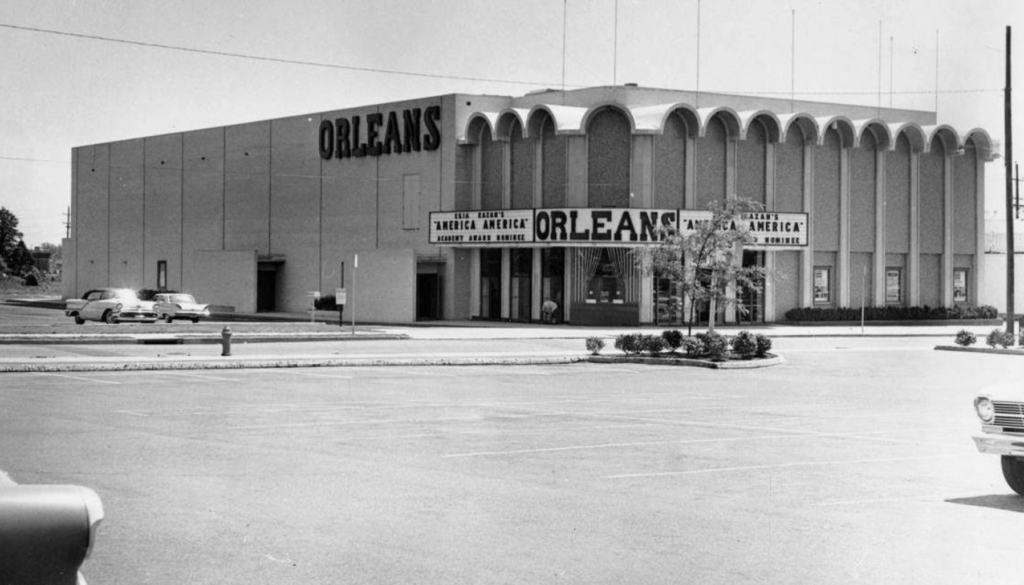
In 1964, Budco Quality Theaters opened a new theater with a seating capacity of around 900. The theater would incorporate the most advanced projection and sound techniques available. Architecturally, the theater also planned to adopt the funnel shape that was characteristic of the latest movie theaters in Europe. At this time, Budco had 22 conventional and outdoor theaters in Delaware, New Jersey, and Philadelphia.
In an article published in 1965, Budco had 26 theaters. Budco’s increase of 4 theaters since the previous article published only a year prior demonstrates their rapid expansion. Budco Quality Theatres not only expanded their chain, they also redeveloped and improved theatres in the area. Clearly, their aim was not only to provide a greater amount of available moviegoing options but also to improve the experience as a whole.
By 1968, Budco circuit planned a $1,500,000 expansion and remodeling program for their 35 theater circuit. From 1965-1968, Budco Quality Theaters grew by 9 theaters, revealing their success and ability to rapidly expand.
In 1972, William Goldman, chairman of the board of William Goldman Theaters, sold 18 theaters to Budco, Inc. in Pennsylvania, New Jersey, and Florida. Among these theaters included the Regency, Midtown, and Goldman, center city’s first-run theaters.

William Goldman opened the Regency Theatre, on June 30, 1967. In 1972, Goldman sold his theatres to Budco, another Philadelphia movie theatre operator. Budco twinned the theatre in 1976, with a wall down the middle, turning it into the equivalent of two bowling lanes or tunnels. At the end of 1987, after the AMC acquisition, the Regency Theatre closed.
By 1973, Budco became the largest independent theater circuit on the East Coast with 65 theaters. One year later, they announced the introduction of 10 more theaters within 6 months. The head of Budco perfectly illustrated the desire of exhibitors for an expansion of moviegoing experiences: “The motion picture business tends to get better in times of a shaky economy. It’s cheap entertainment despite the increases in ticket prices.”
Schlanger attributed knowledge of the community to a large part of his success. Interestingly, he discovered that sex films helped to boost his profits: “There’s a real place in the entertainment market for that type of picture. I make money on them, so that taints my view. But I don’t think they have the effect on audiences that do-gooders say.”
Schlanger also saw Center City as a rich area in Philadelphia for theater expansion: “Center City is still the mecca for entertainment in Philadelphia and I am confident of the future of the motion picture theatre in the Chestnut Street area.”
Another decision that inspired a major trend for Budco theaters was the choice to split one screen theaters into two. First, Budco reopened the Budco-Goldman I and Budco-Goldman II. The theater was now set to gross $20 million in the following year. Structurally, Budco converted the Goldman into two 600-seat theaters, while only losing 29 seats total from the single theater. Schlanger was in touch with another overall trend in moviegoing, suggesting, “people prefer intimate settings to the palaces.”
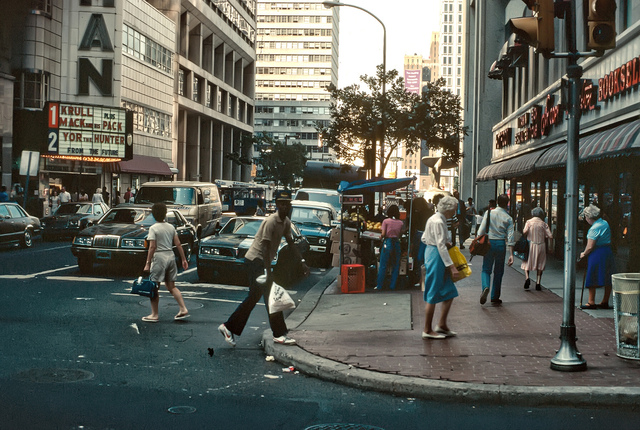
In 1976, Budco continued this trend by splitting up the Regency Theater into I and II. Midtown Theater was the company’s only single first-run house in Center City, which indicated that in densely populated urban spaces, theaters were shifting towards a multi-screen model.
By 1977, Budco opened its first fourplex operation in Philadelphia and second in the entire theater chain, the “Orleans Four” had a total of 2,700 seats. This suggests that as Budco continued to grow and expand as a chain, they continued to shift their business model and develop their theatres according to changing outside pressures. The assistant to the President of Budco, Willard Matthews, suggested that increasing the number of screens was necessary as a response to the increasing demands of distributors to have films be played in this theater (a particularly popular one in Philadelphia city proper). Budco was shifting towards adopting the multiplex model prior to AMC stepping in, revealing that the shift toward larger multiplexes may have been an unavoidable development in the movie theatre industry in order to accommodate a changing moviegoing and film exhibition landscape.
Ultimately, after years of expansion and growth, AMC Philadelphia purchased Budco Theaters inc. for $20 million. By the time of purchase, Budco’s circuit consisted of 113 screens in 42 locations. AMC discussed how their intentions were to improve the moviegoing experience: “Our objective is not simply to achieve a leadership position in the market but to enhance the overall quality and accessibility of the movie-going experience for the community”
The AMC purchase of the Budco theater chain in 1987 (alongside UA’s purchase of the Sameric theater chain) marked the active effort of these larger companies to redevelop old school theater chains (which were primarily single or twin screens) into multiplexes. This moment marks the immense changes brought about by the acquisition and redevelopment of the Budco theatre chain by AMC — replacing the older facilities with new ones and providing the moviegoing public with more options by housing 8-10 screens all under one roof. The AMC purchase and plans to renovate and expand the Budco Theatres (and other large companies purchasing of independent theatre chains) marks a major and permanent shift in the Philadelphia cinema scene.

Do you have any research specifically about the Goldman Theaters and its evolution from beginning to end?
Hi Lisa, thank you so much for leaving a comment! Can you share why you are interested in this particular theater? I can encourage my students to look into it.
My first job was working at Goldman theater as a usher in 1966, Mr Goldman interviewed me for the position and hired me at 65 cents a hour. I remember standing at the entrance to the seats for hours.
Thank you for the comment! We’d be interested in hearing more of your story.